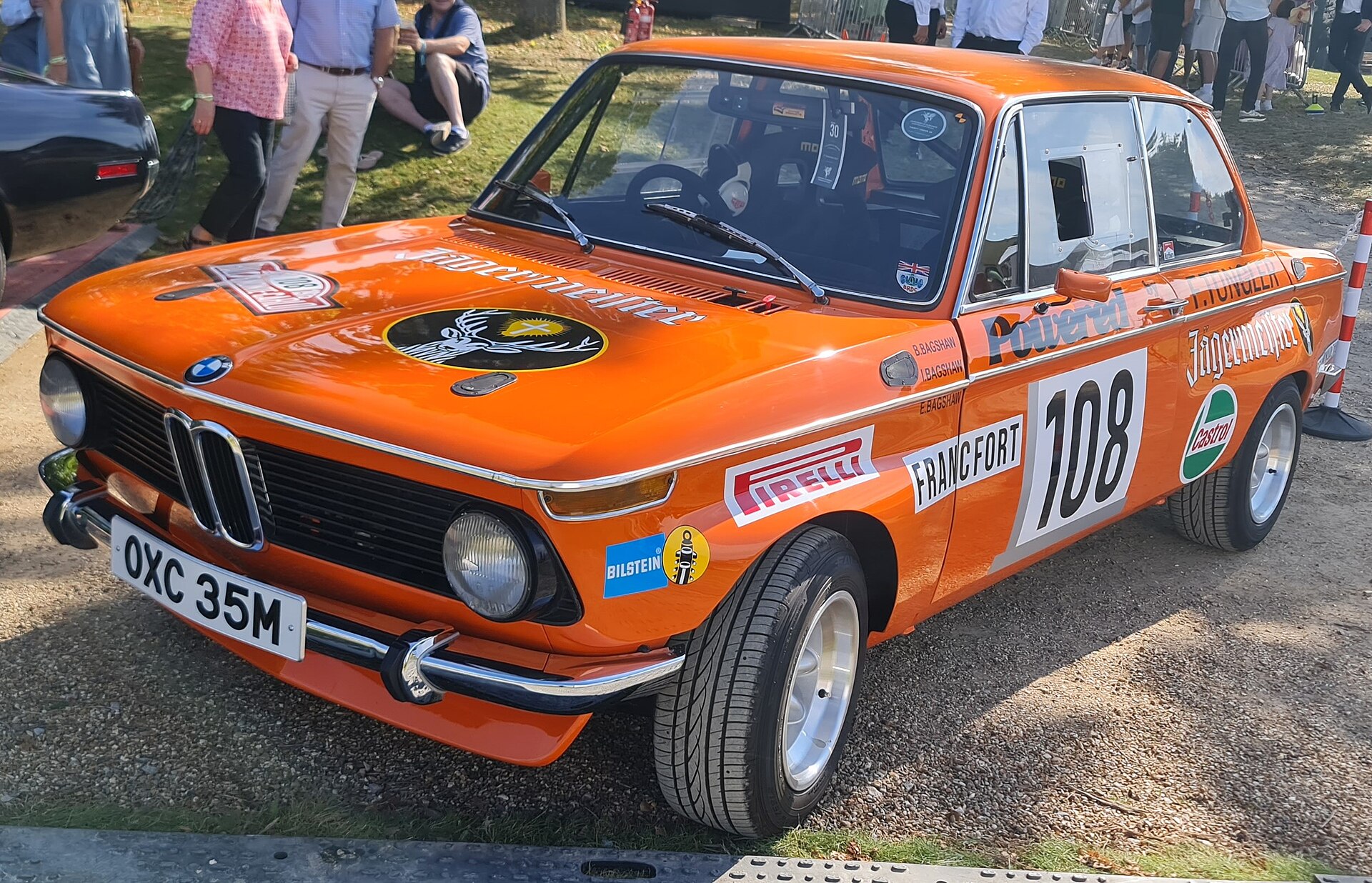
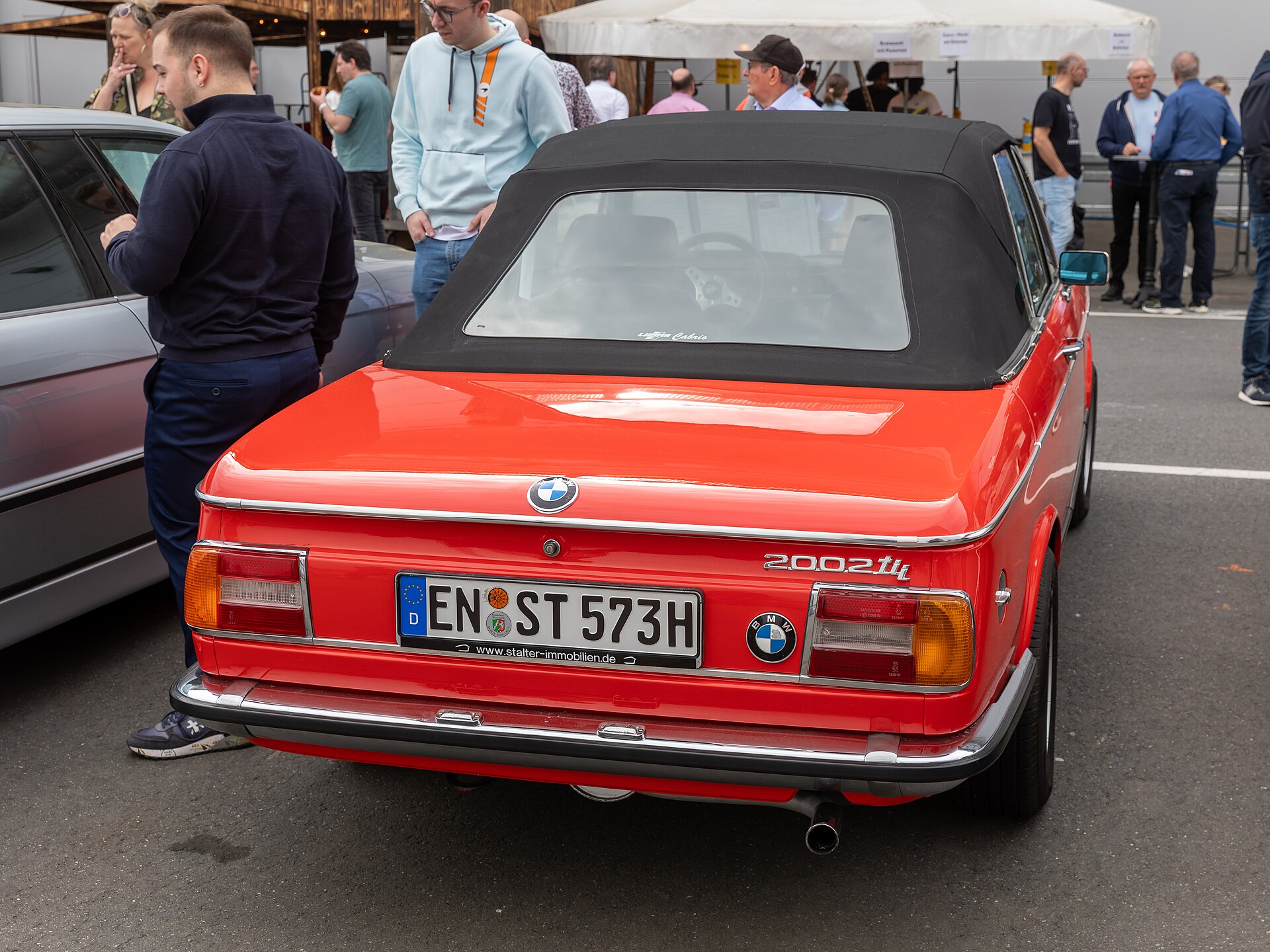
1973 BMW 2002 tii in period rally livery, Hampton Court Concours 2023 Photo: MrWalkr via Wikimedia Commons · License: CC BY-SA 4.0
BMW 2002
The small sports sedan that made BMW's name in America.
The BMW 2002 grew out of the 02 Series, a shorter, two-door version of BMW's "New Class" sedans that debuted as the 1600-2 in 1966. Two BMW insiders, product-planning director Helmut Werner Bönsch and M10 engine designer Alex von Falkenhausen, had each separately fitted a 2.0-liter M10 into a 1600-2 for personal use. When they discovered they'd done the same thing, they made a joint proposal to the board. At the same time, U.S. importer Max Hoffman was asking for a sportier 02 he could sell in America. The 2002 arrived in 1968 and, in Wikipedia's summary, went on "to establish a new reputation for BMW as a maker of high-quality affordable performance vehicles."
What made it special
Hagerty calls the 2002 perhaps the most famous of BMW's New Class line, crediting it with reviving the brand's "historically underwhelming international reputation" through a mix of power, agility, style and a reasonable price. In the U.S. it came as the single-carburetor 100 hp 2002 and the fuel-injected 2002 tii. Europe also got cabriolet, targa and Touring hatchback versions. The headline act was the 2002 turbo, launched at the 1973 Frankfurt show as BMW's and Europe's first turbocharged production car. It arrived in the middle of the oil crisis, and only 1,672 were built.
Key specs
Engine: 2.0-liter (1,990 cc) SOHC M10 inline-four
2002 (U.S.): 100 hp, single carburetor
2002 tii: 130 hp with Kugelfischer mechanical fuel injection, 118 mph top speed (Hagerty)
2002 turbo: 170 PS (168 hp) at 5,800 rpm and 240 N·m, 211 km/h (131 mph) top speed
Collector values and news
The 02 Series turned 60 this year. Hagerty's anniversary market report puts a #1 (Concours) 2002 Turbo at $231,000 and a #4 (Fair) Turbo at $57,200, while a Fair 1602 can be had for about $7,700. Hagerty's Price Guide values a 1973 2002 tii at $124,000 (#1), $80,500 (#2), $37,500 (#3, Good) and $14,900 (#4). Hagerty's valuation team notes that soaring Turbo prices have pushed some buyers toward the tii as "the next best thing."
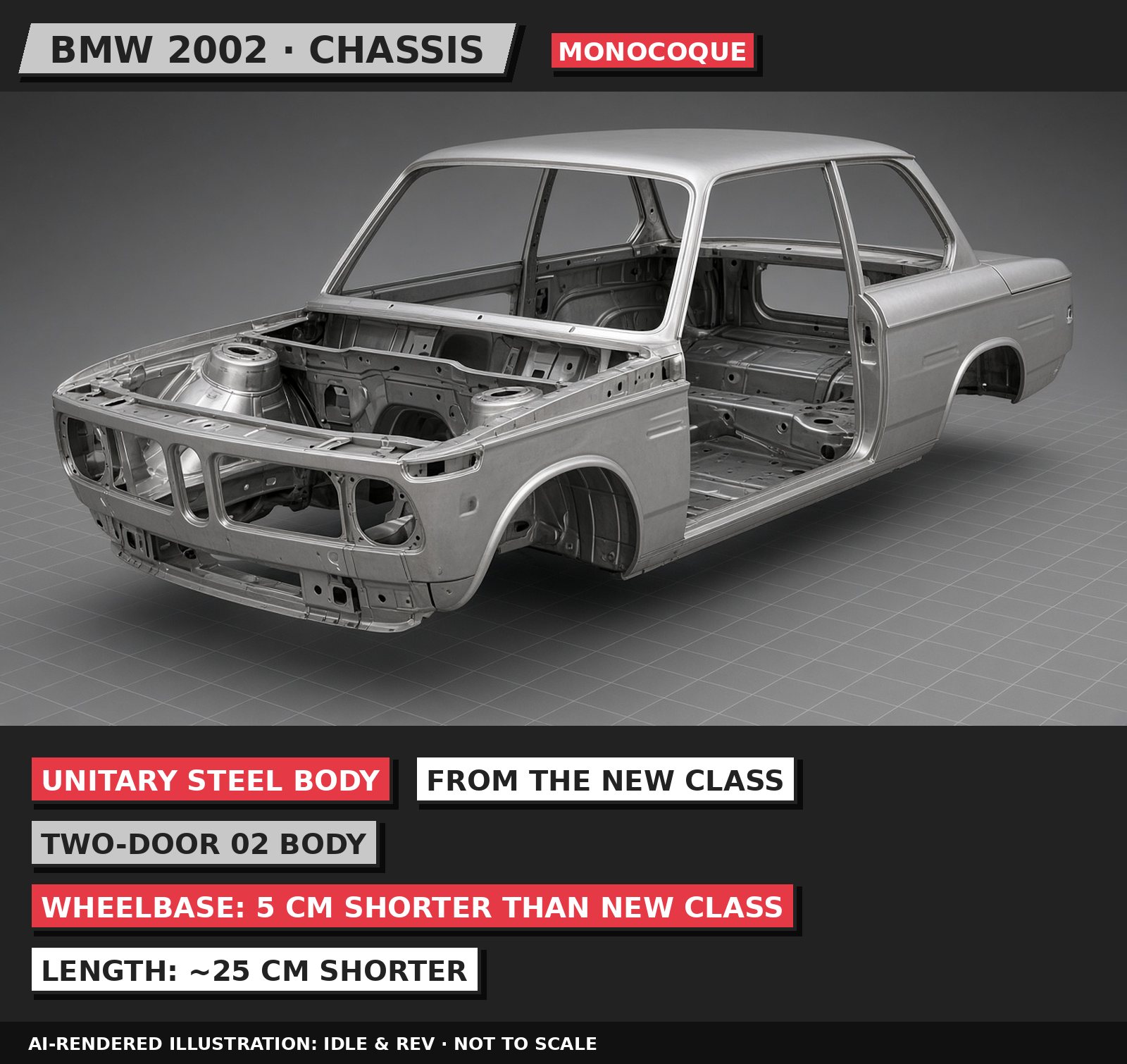
Unitary (monocoque) steel body, from the New Class sedans
Two-door 02 body: wheelbase 5 cm shorter and length about 25 cm shorter than the New Class
Shrinking a proven sedan structure gave BMW a light, stiff, compact car without starting from scratch. Less mass on the same hardware is exactly why it felt so eager.
Illustration: Idle & Rev (AI-rendered, for illustration; not to scale)
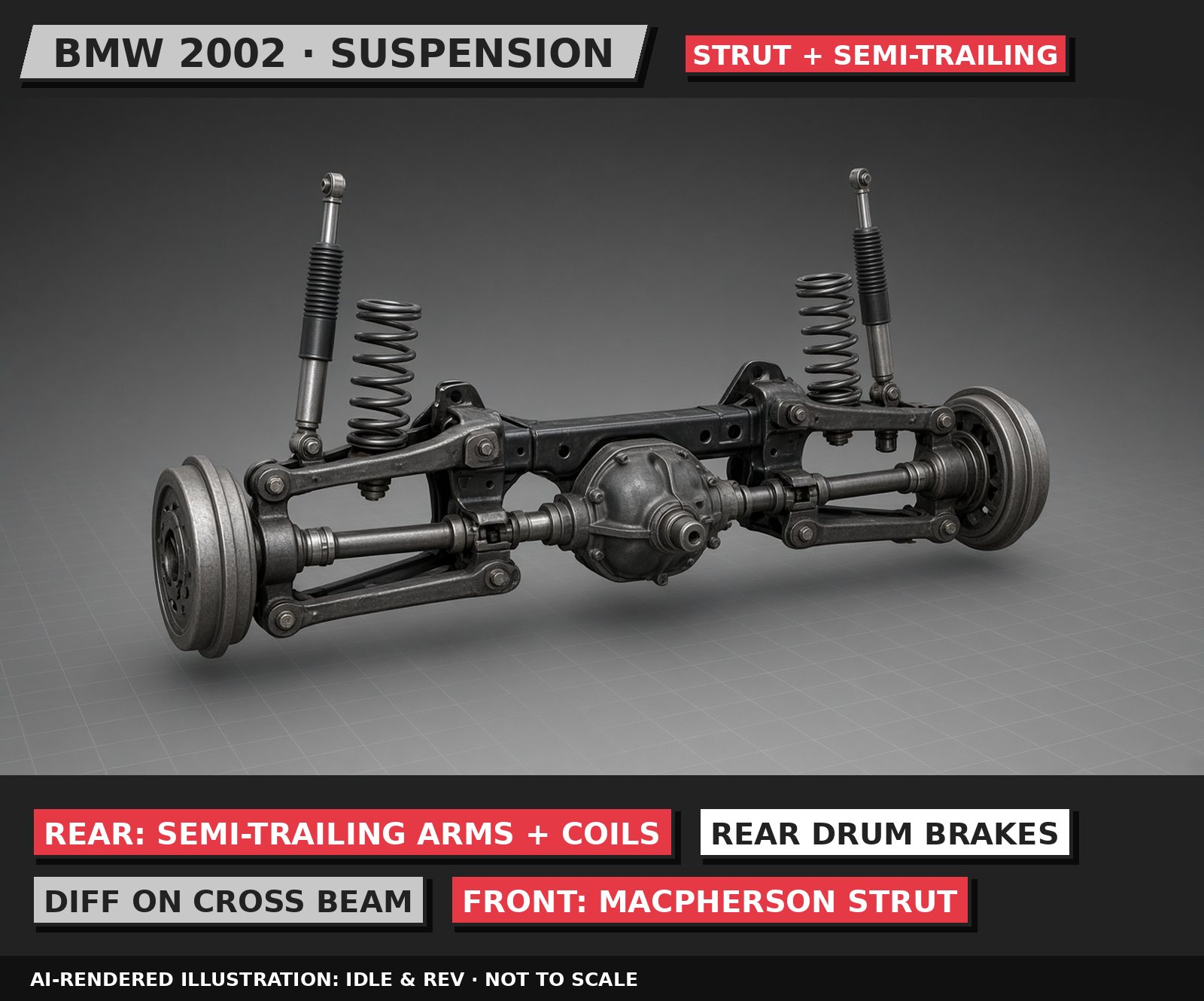
Suspension
Front: MacPherson struts (New Class layout)
Rear: independent, coil springs with semi-trailing arms pivoted from a stout cross beam that also carries the differential
Front disc brakes
Independent rear suspension was unusual in an affordable small sedan of the era, and it is a big part of why the 2002 handled like a sports car. Semi-trailing arms became a BMW trademark for decades.
Illustration: Idle & Rev (AI-rendered, for illustration; not to scale)
Engine / Powertrain
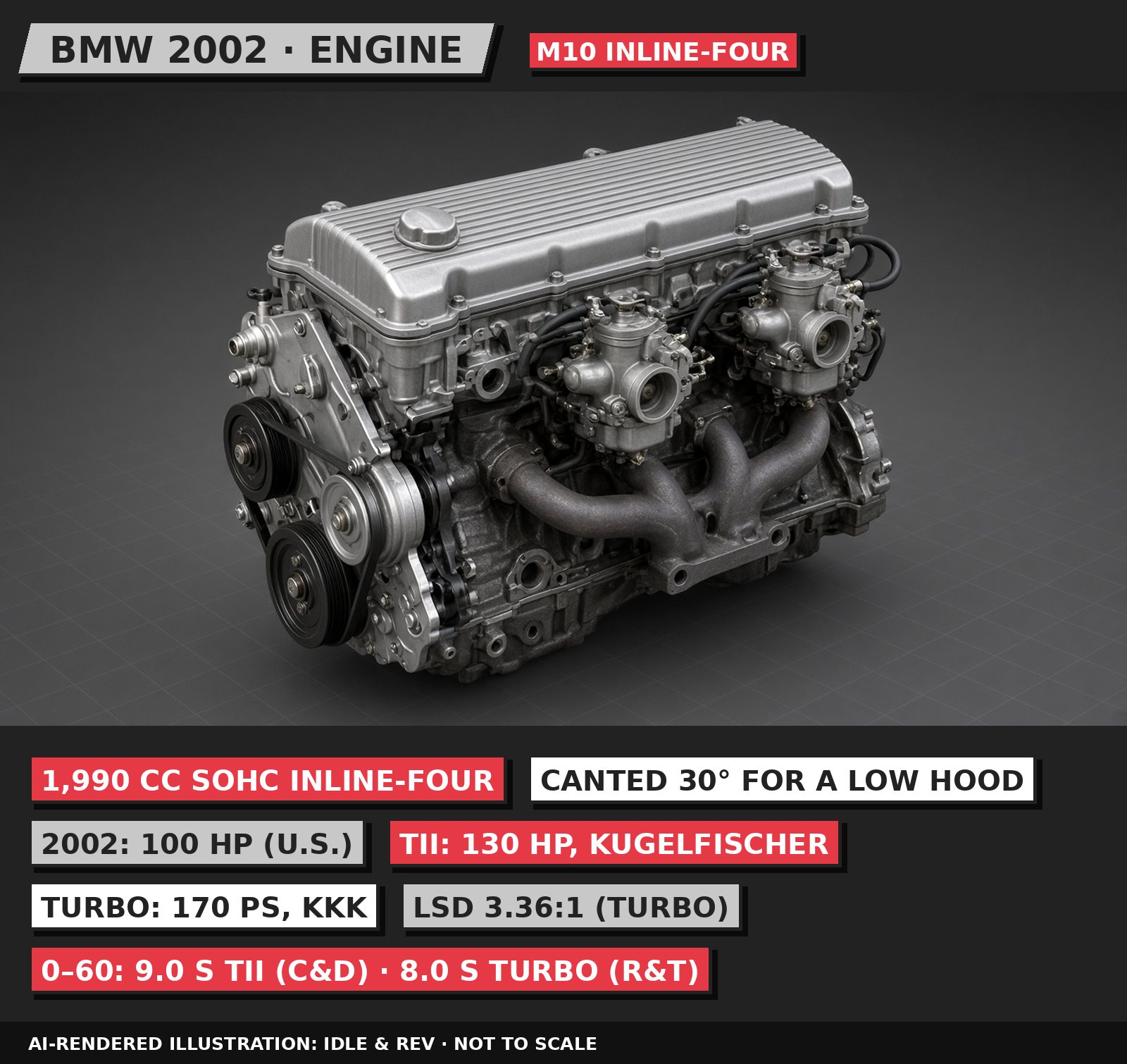
0–60 mph:2002 tii 9.0 s (Car and Driver, 1972 tii test); 2002 turbo 8.0 s (Road & Track first drive); BMW claimed 0–100 km/h (62 mph) in 6.9–7.0 s for the turbo. Base 2002: no magazine 0–60 figure found
M10 SOHC inline-four, 1,990 cc, canted 30° to allow a low hood
The M10 was so robust it later underpinned BMW's turbo Formula 1 engines. In the 2002 it delivers a rev-happy, torquey feel, and the turbo's late surge made it a 1970s sensation.
Illustration: Idle & Rev (AI-rendered, for illustration; not to scale)
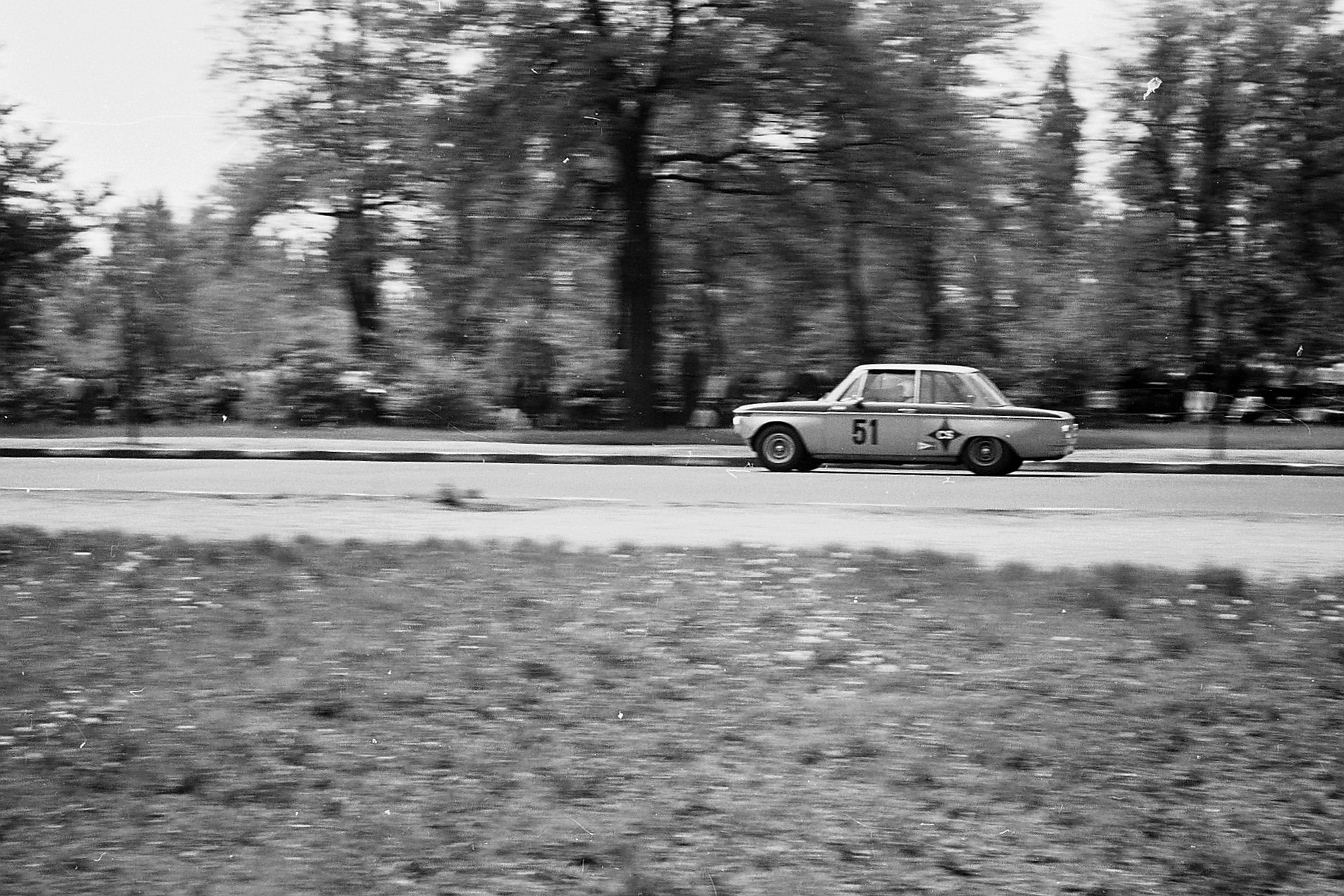
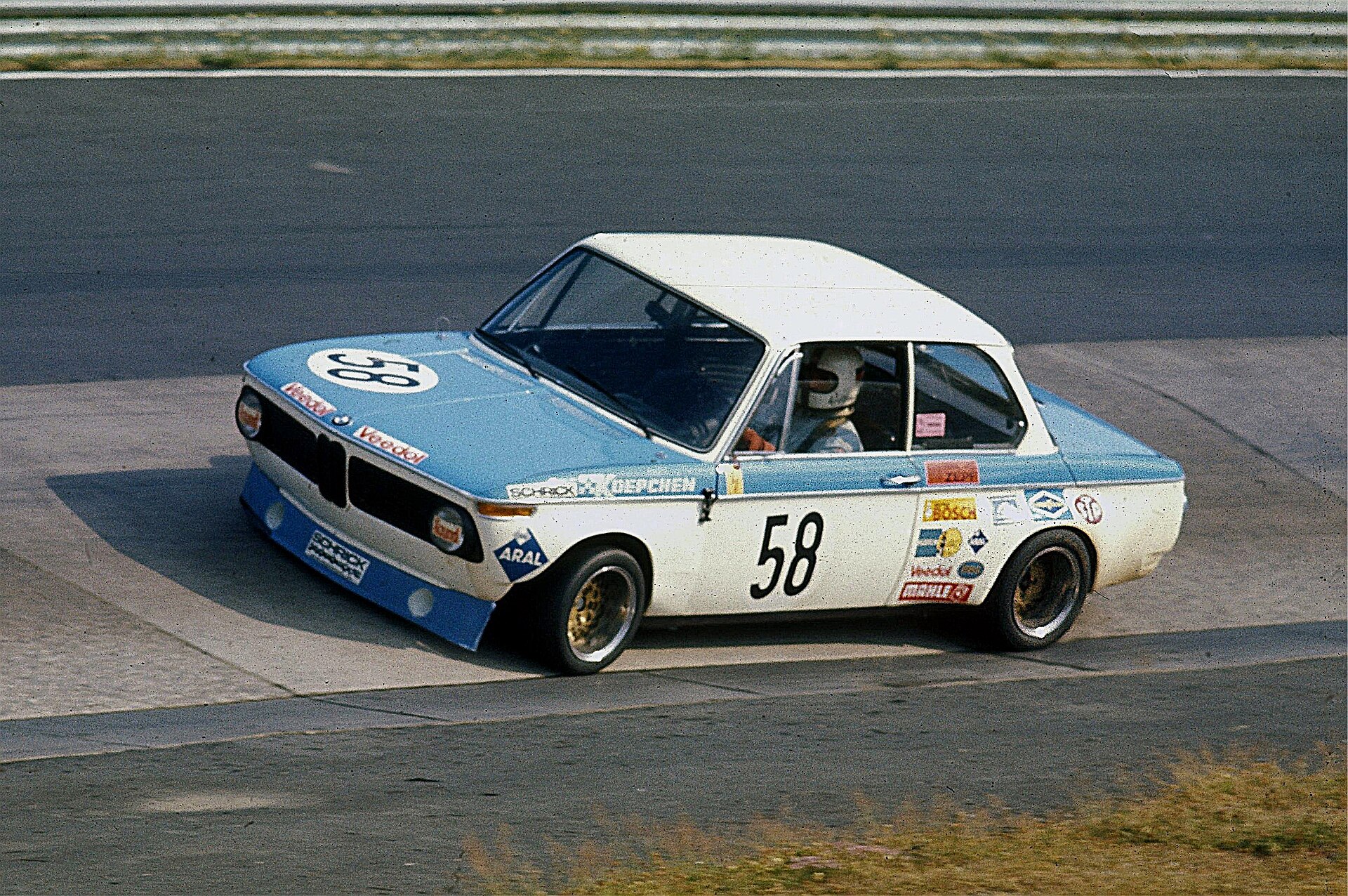
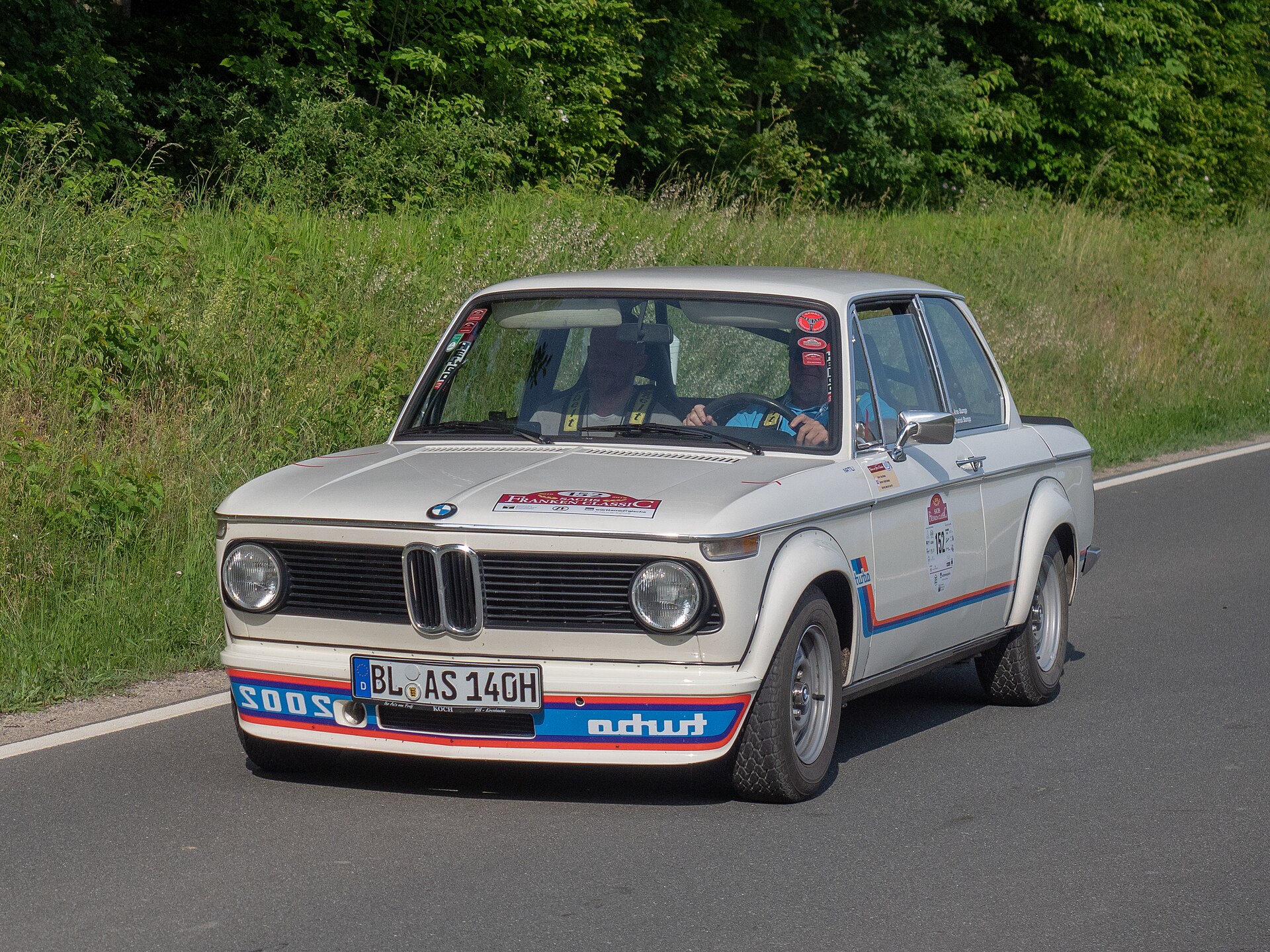
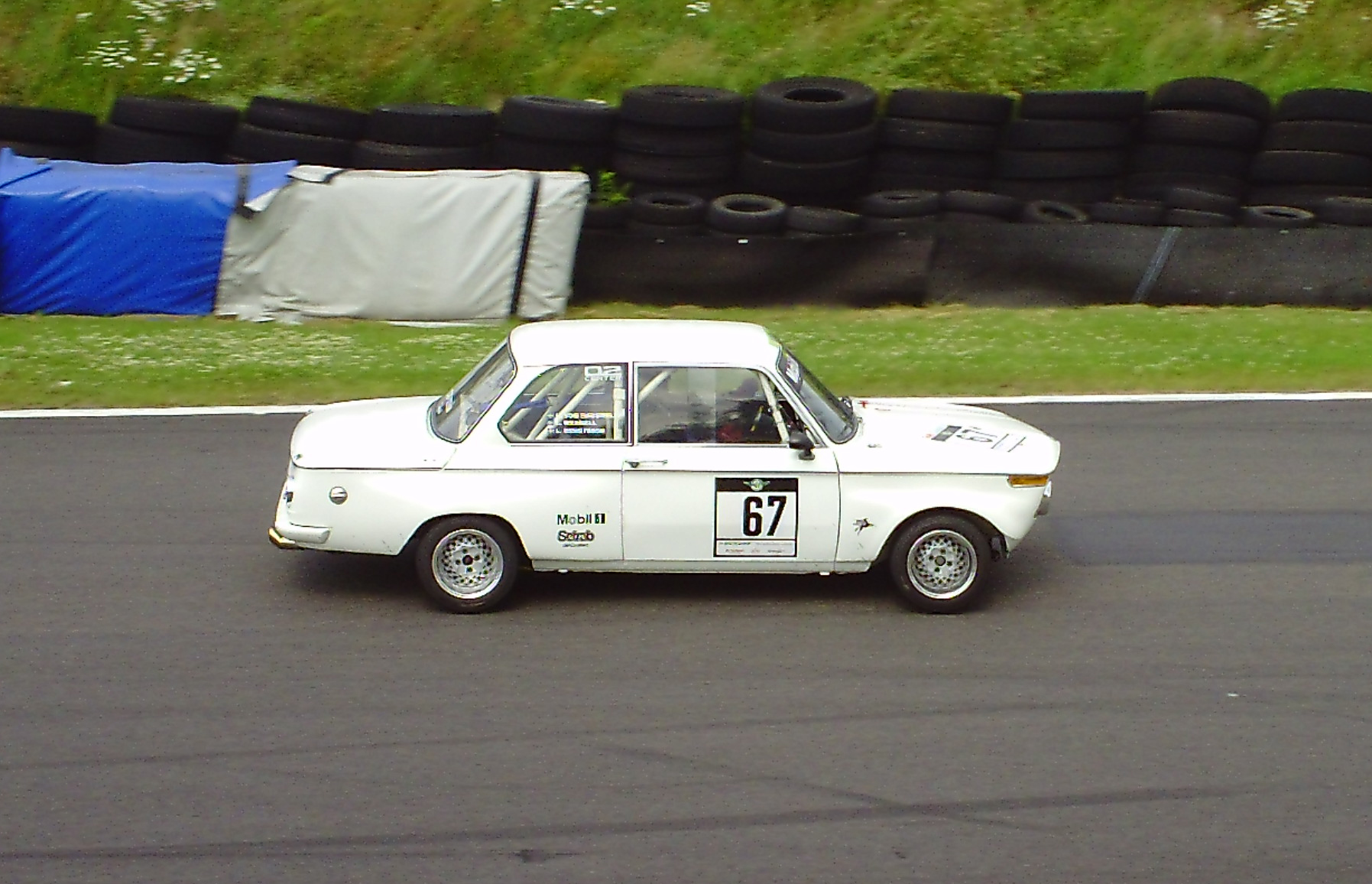
Hans-Joachim Stuck and Clemens Schickentanz won the first 24 Hours Nürburgring in 1970 in a 2002, and Dieter Quester and Hubert Hahne won the June 1969 European Touring Car Championship round at Brands Hatch in the turbocharged factory 2002 TiK. In rallying, Sobiesław Zasada won the 1971 European Rally Championship in a 2002 ti, and Achim Warmbold and Jean Todt won the 1973 Austrian Rally, a round of the first World Rally Championship season, in a 2002 tii.
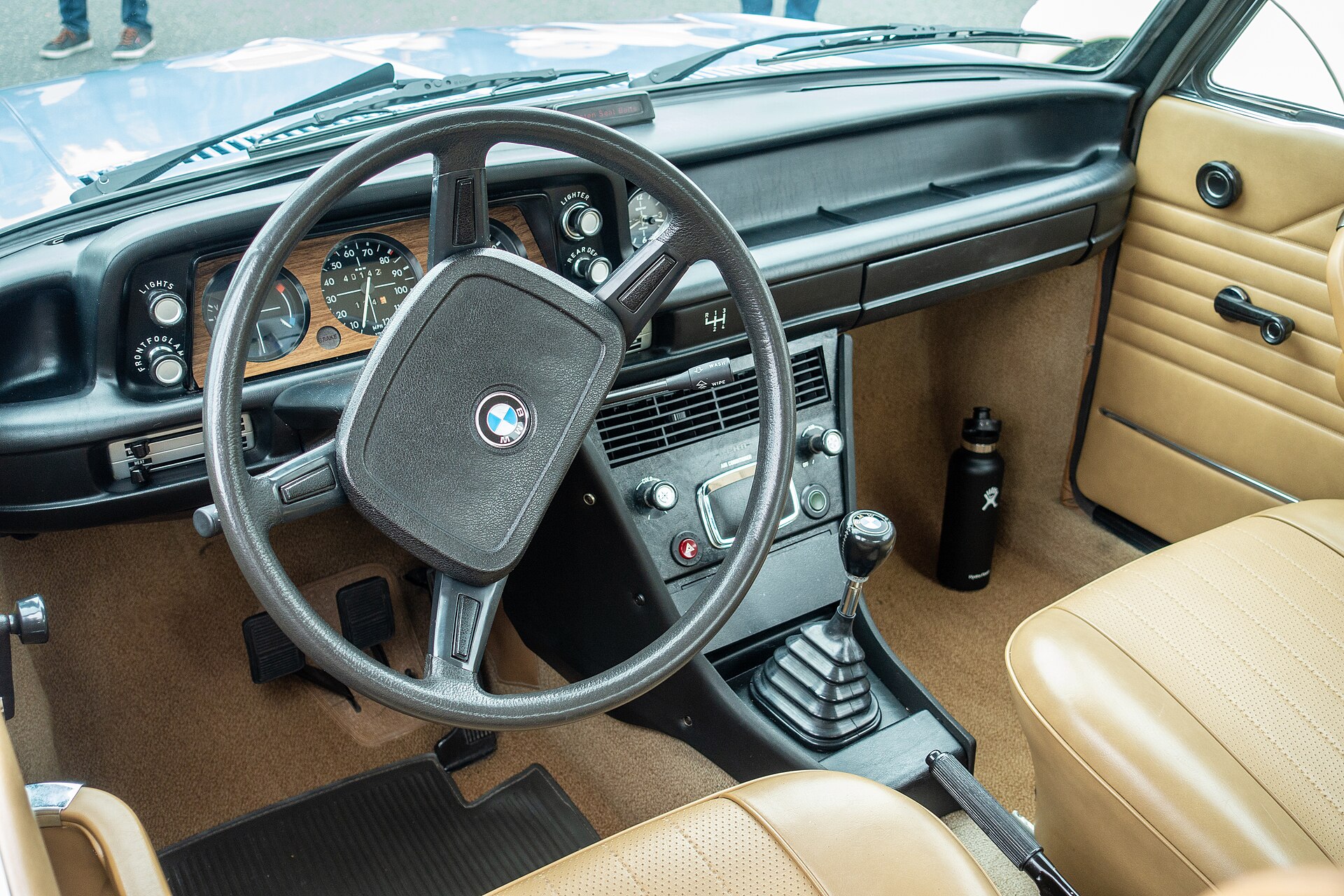
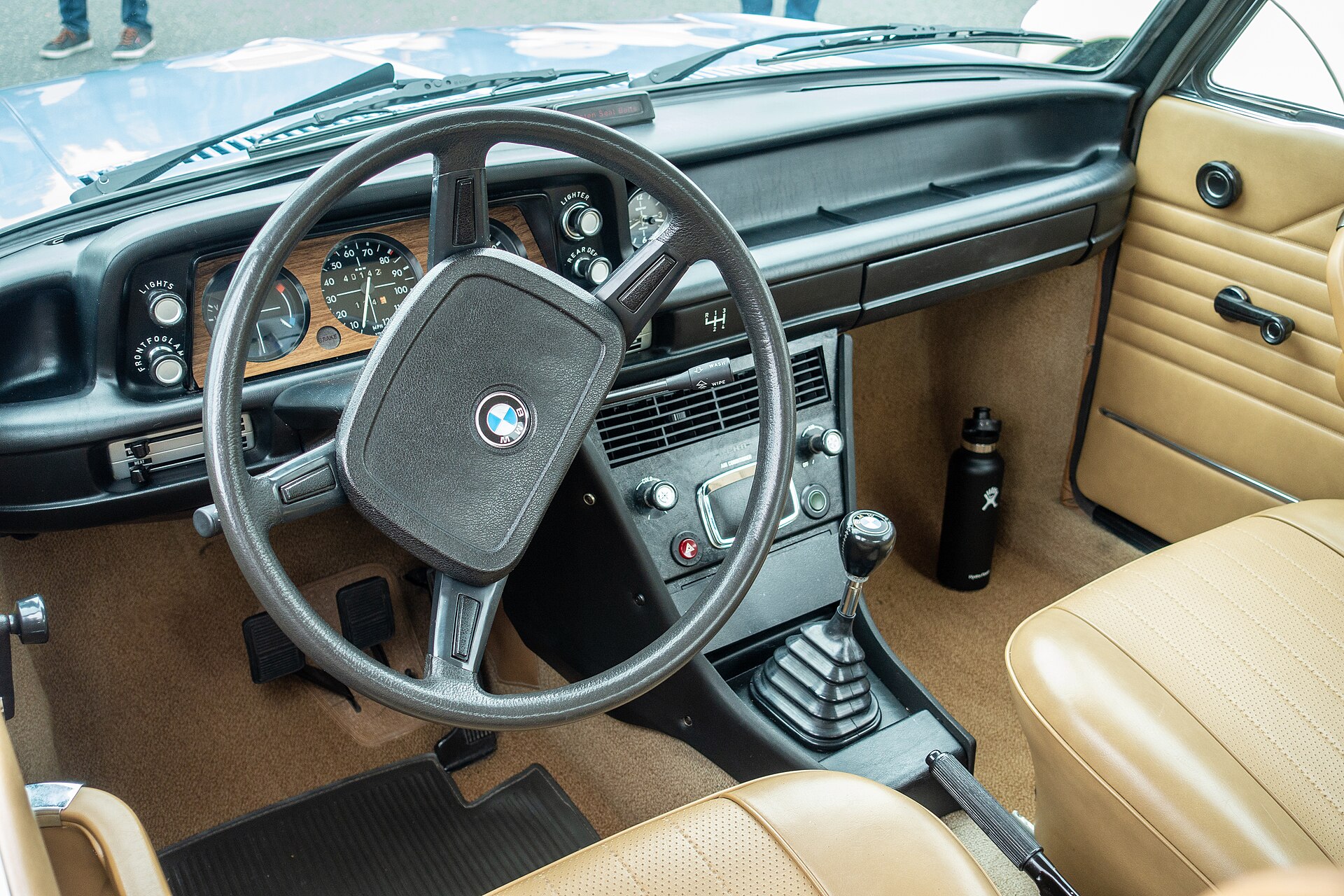
BMW 2002 ti race car in a European Touring Car Championship round, Budapest Grand Prix, 1969 Photo: FOTO:Fortepan — ID 16510: Adományozó/Donor: Tóth Károly dr. via Wikimedia Commons · License: CC BY-SA 3.0Helmut Kelleners in the Koepchen BMW 2002, practice for a 6-hour race, July 1973 Photo: Lothar Spurzem via Wikimedia Commons · License: CC BY-SA 2.0 deBMW 2002 turbo (E20) at the Sachs Franken Classic 2018 rally, Stage 1 Photo: Ermell via Wikimedia Commons · License: CC BY-SA 4.0Ulf von Hauswolff's BMW 2002 in a historic race at Falkenbergs Motorbana, 2011 Photo: Green Yoshi via Wikimedia Commons · License: CC BY-SA 3.0Interior: BMW 2002 tii dashboard Photo: Marty B via Wikimedia Commons · License: CC BY-SA 2.0
On track
BMW 2002 at speed · AI-rendered illustration by Idle & Rev, not real footage