
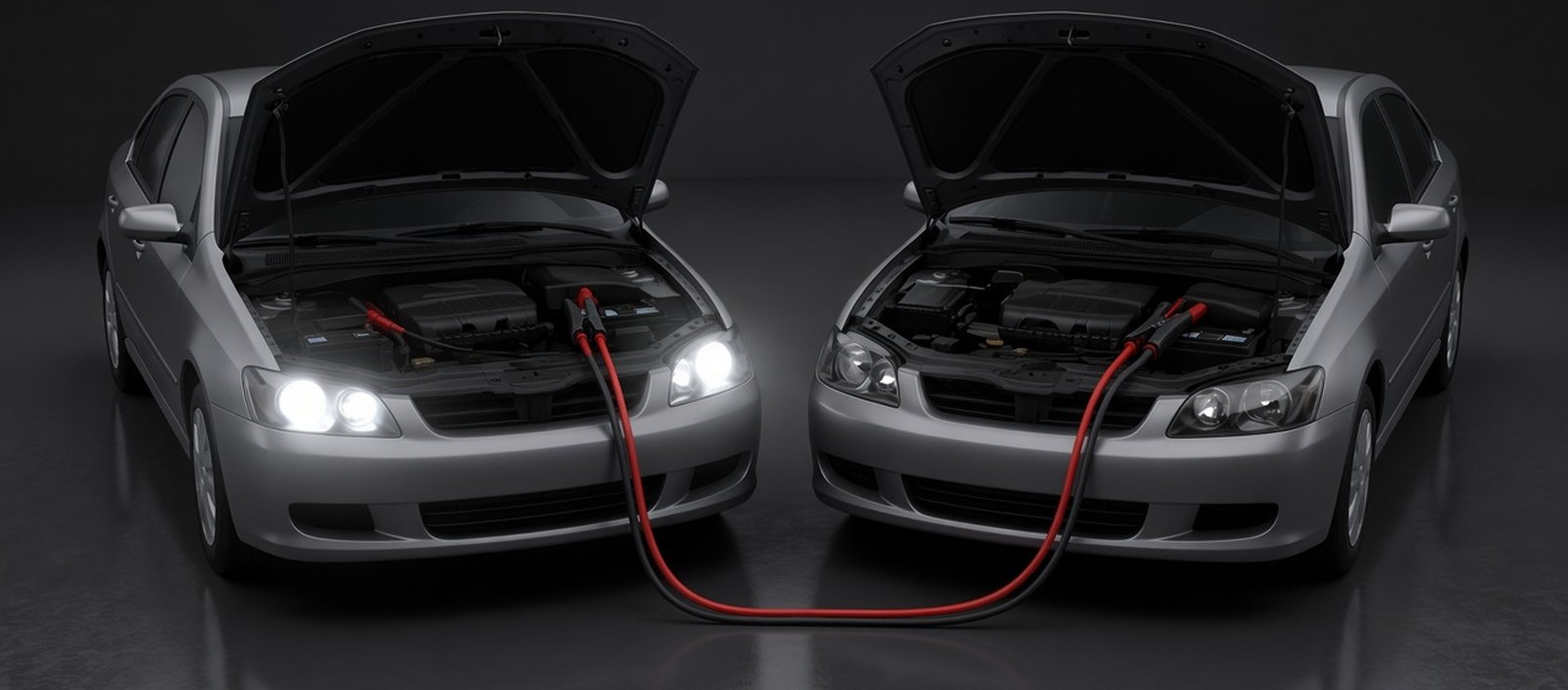
How to jump-start a car safely
5 min read
The right cable order, the safe grounding point, and what to do once the engine is running.
A dead battery is one of the most common reasons a car won't start, and with a set of jumper cables and a second car you can usually fix it in 10 minutes. The order you connect the cables matters: it's designed to keep the final spark away from the battery, which can give off hydrogen gas.
Consumer Reports' chief mechanic says to follow your owner's manual to the letter, because some cars (especially hybrids, EVs and cars with remote jump posts under the hood) have their own procedure.
What you need
- Jumper cables in good condition, with no frayed wire or exposed metal (AAA suggests 10 to 20 feet)
- A running car with a healthy battery of the same voltage (12V on almost every passenger car)
- A rag or brush to clean grimy terminals
- Or a charged portable jump starter, which replaces the second car
Step by step
- Park close, everything offPark the donor car close enough for the cables to reach, but don't let the cars touch. Set both parking brakes, turn off both ignitions and switch off lights and accessories. Open both hoods and find the + and − terminals; wipe them clean if needed.
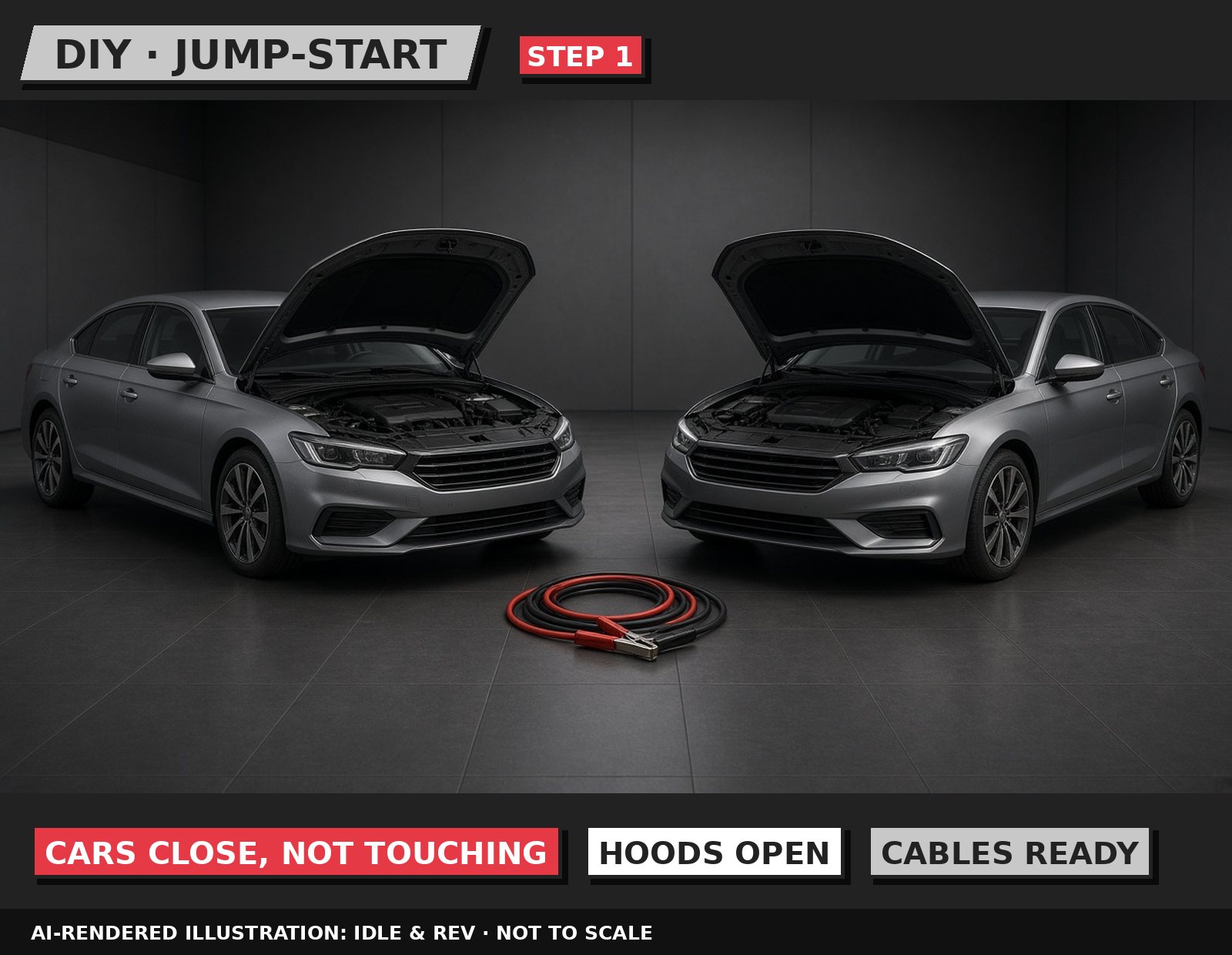
Illustration: Idle & Rev (AI-rendered, for illustration; not to scale) - Red clamp to the dead battery's positiveClamp one red end firmly to the positive (+) terminal of the dead battery. Wiggle it so it bites.
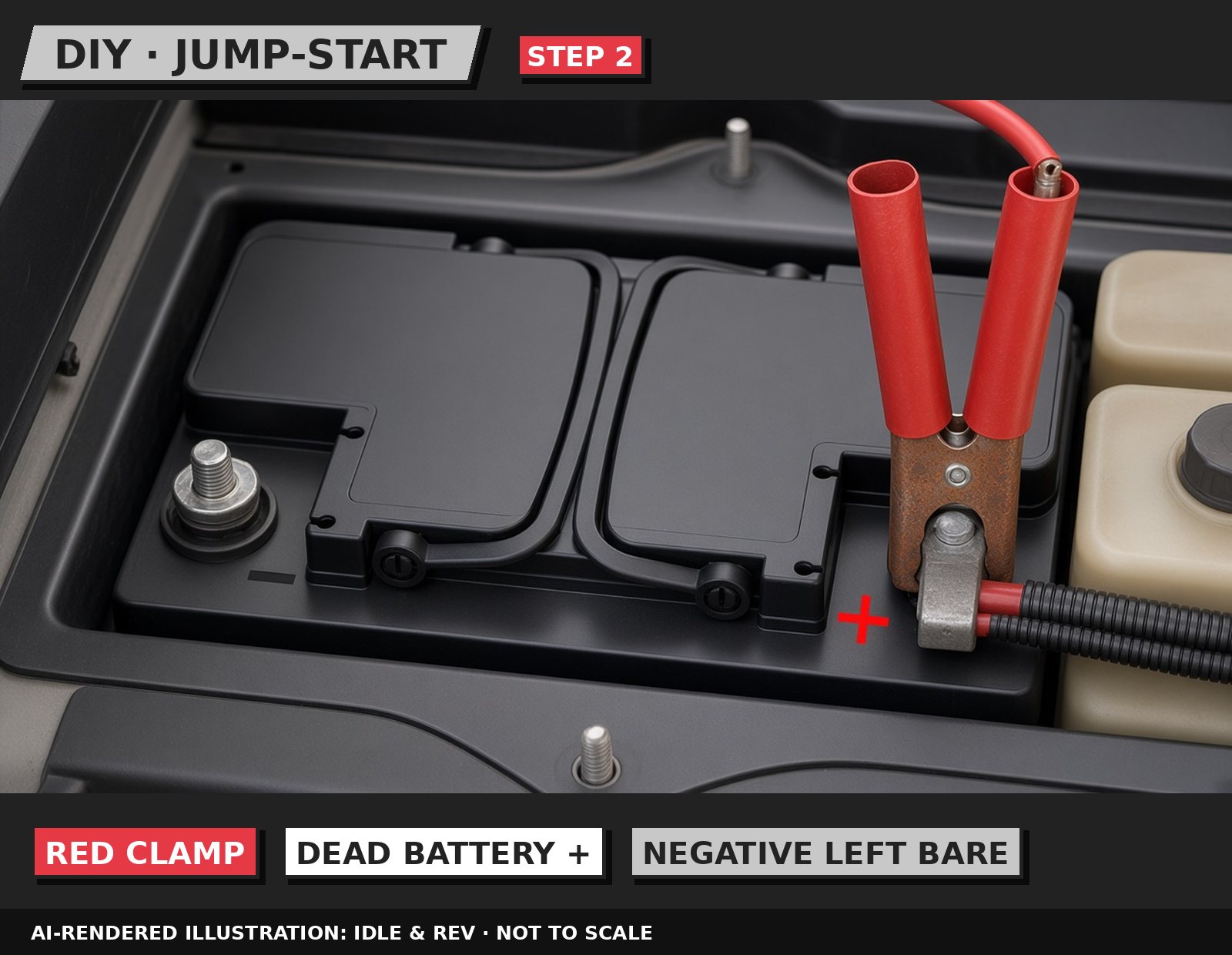
Illustration: Idle & Rev (AI-rendered, for illustration; not to scale) - Other red clamp to the good battery's positiveAttach the other red clamp to the positive (+) terminal of the donor car's battery.
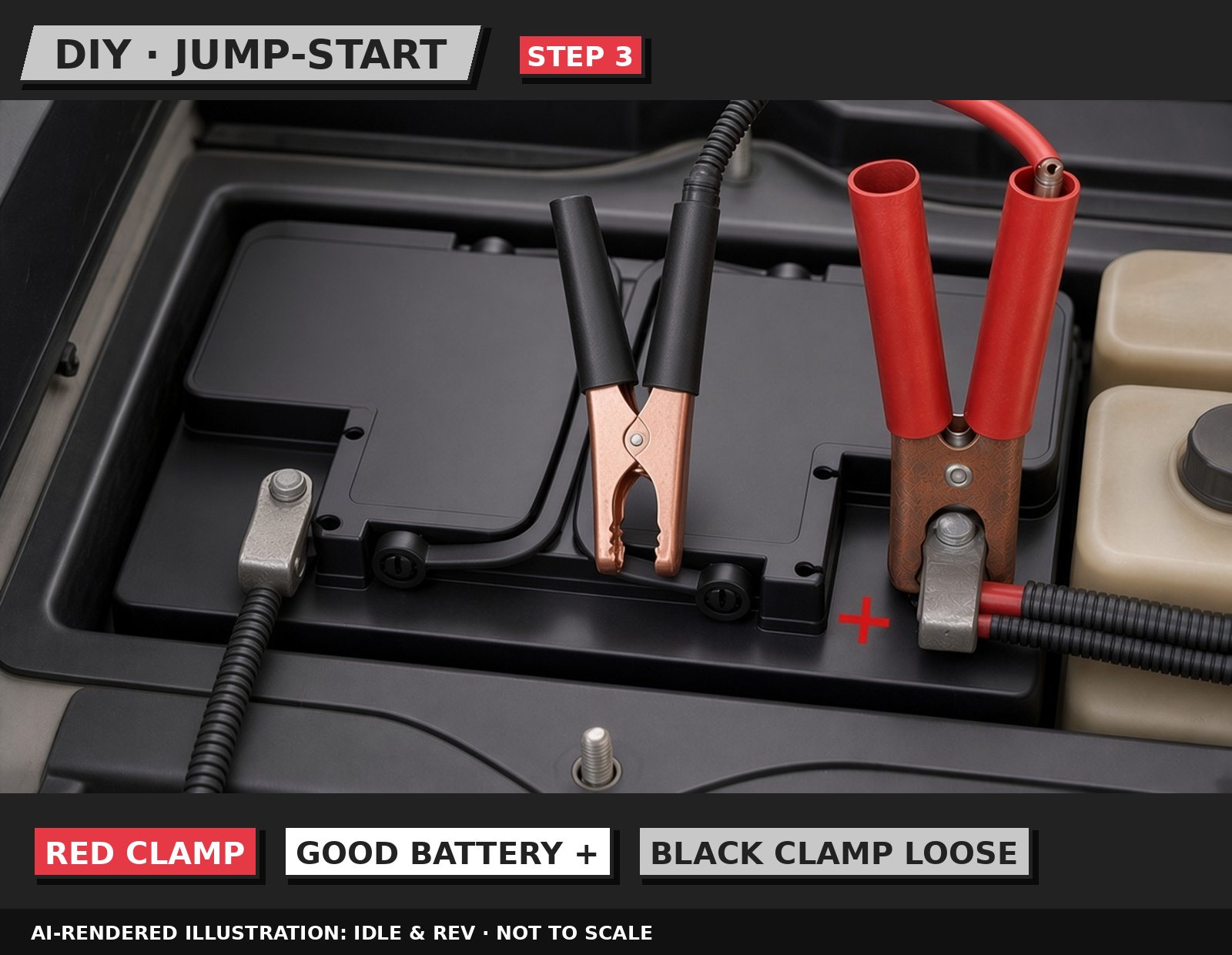
Illustration: Idle & Rev (AI-rendered, for illustration; not to scale) - Black clamp to the good battery's negativeConnect one black clamp to the negative (−) terminal of the donor battery.
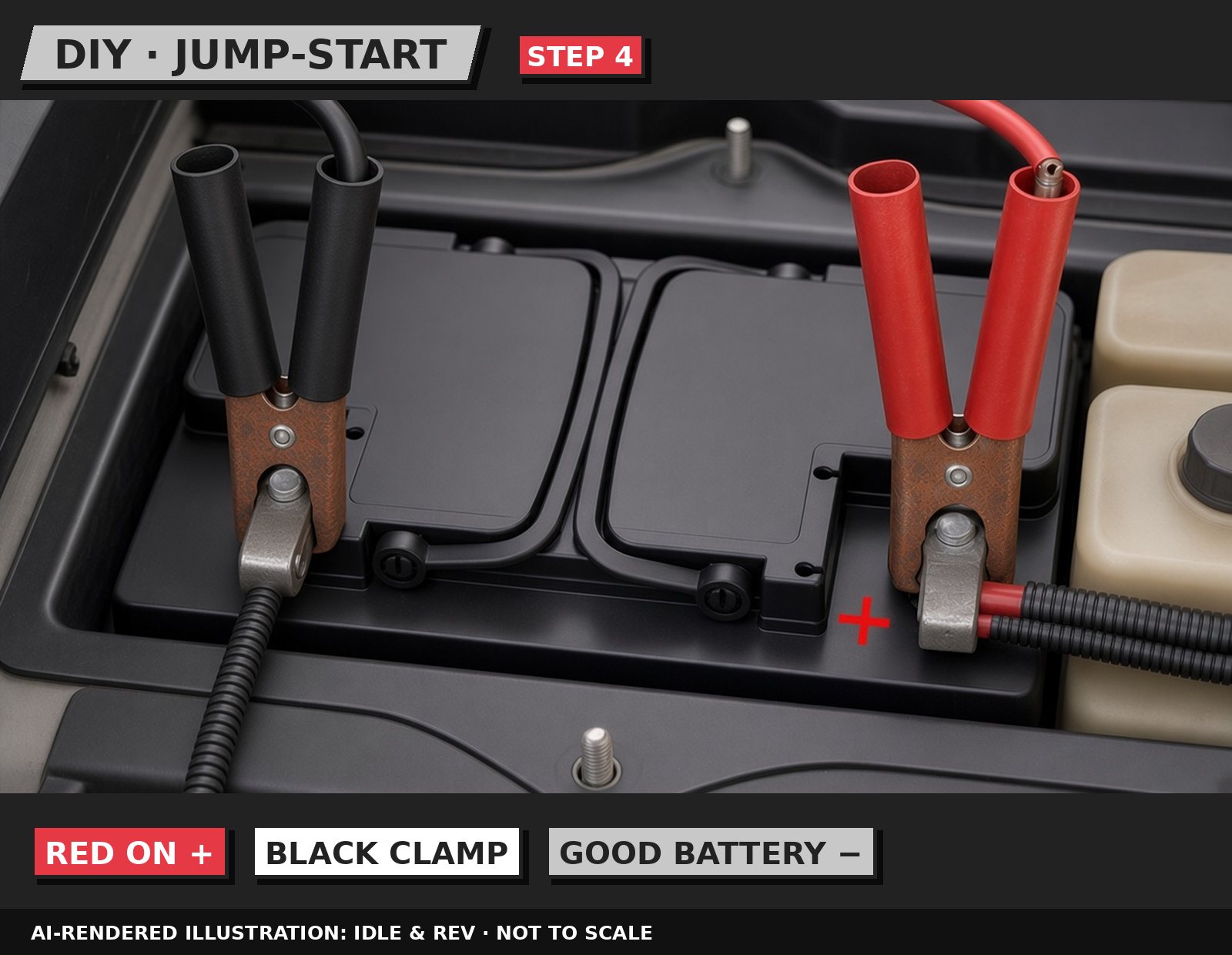
Illustration: Idle & Rev (AI-rendered, for illustration; not to scale) - Last black clamp to bare metal on the dead carAttach the final black clamp to clean, unpainted metal on the dead car, such as a bare chassis stud or a thick bolt on the engine block, away from the battery and fuel system. AAA, Consumer Reports and the AA all say not to use the dead battery's negative terminal; the last connection can spark.
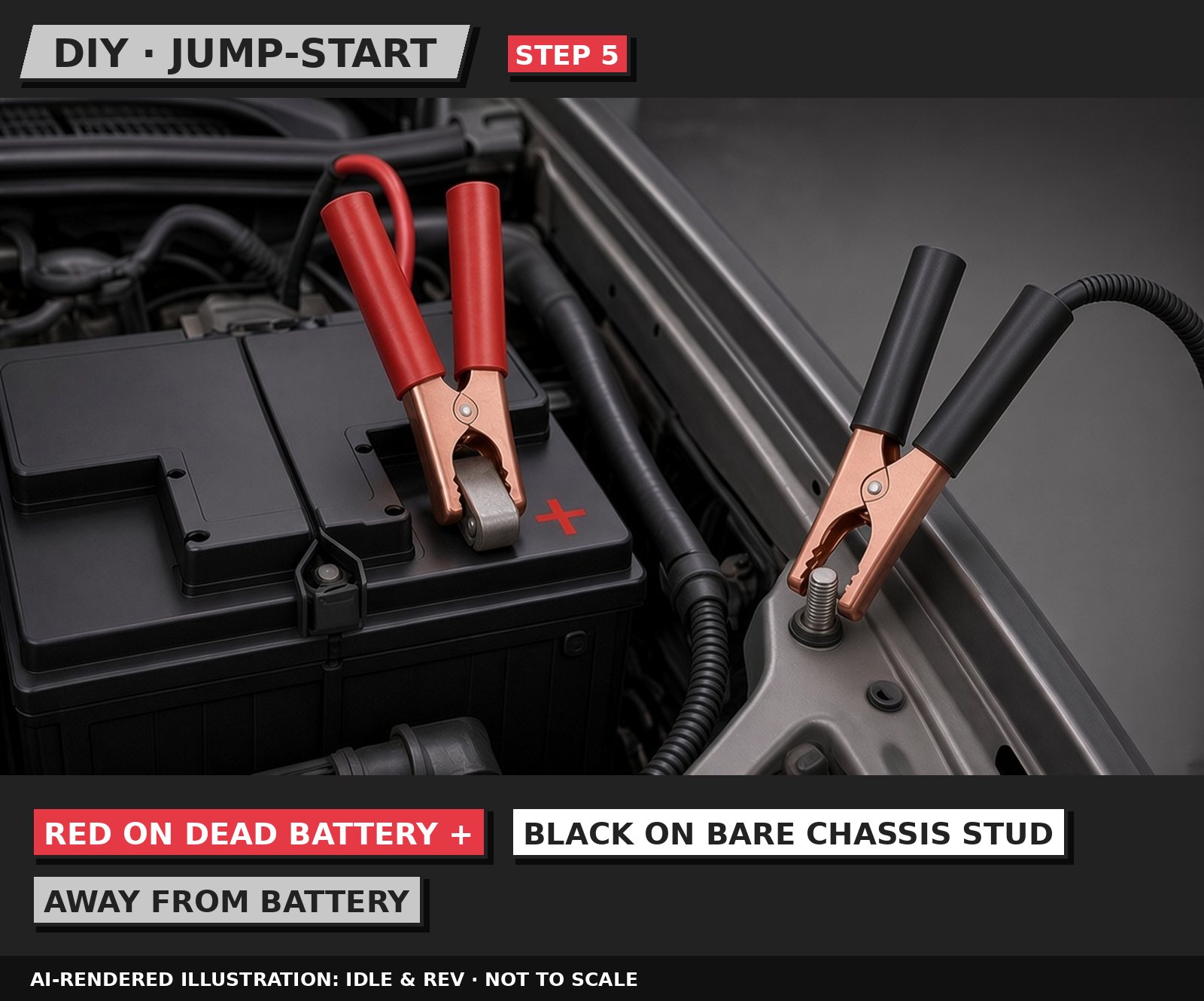
Illustration: Idle & Rev (AI-rendered, for illustration; not to scale) - Start the donor carStart the donor car and let it run for three to five minutes, as AAA advises, so its alternator puts some charge into the dead battery.
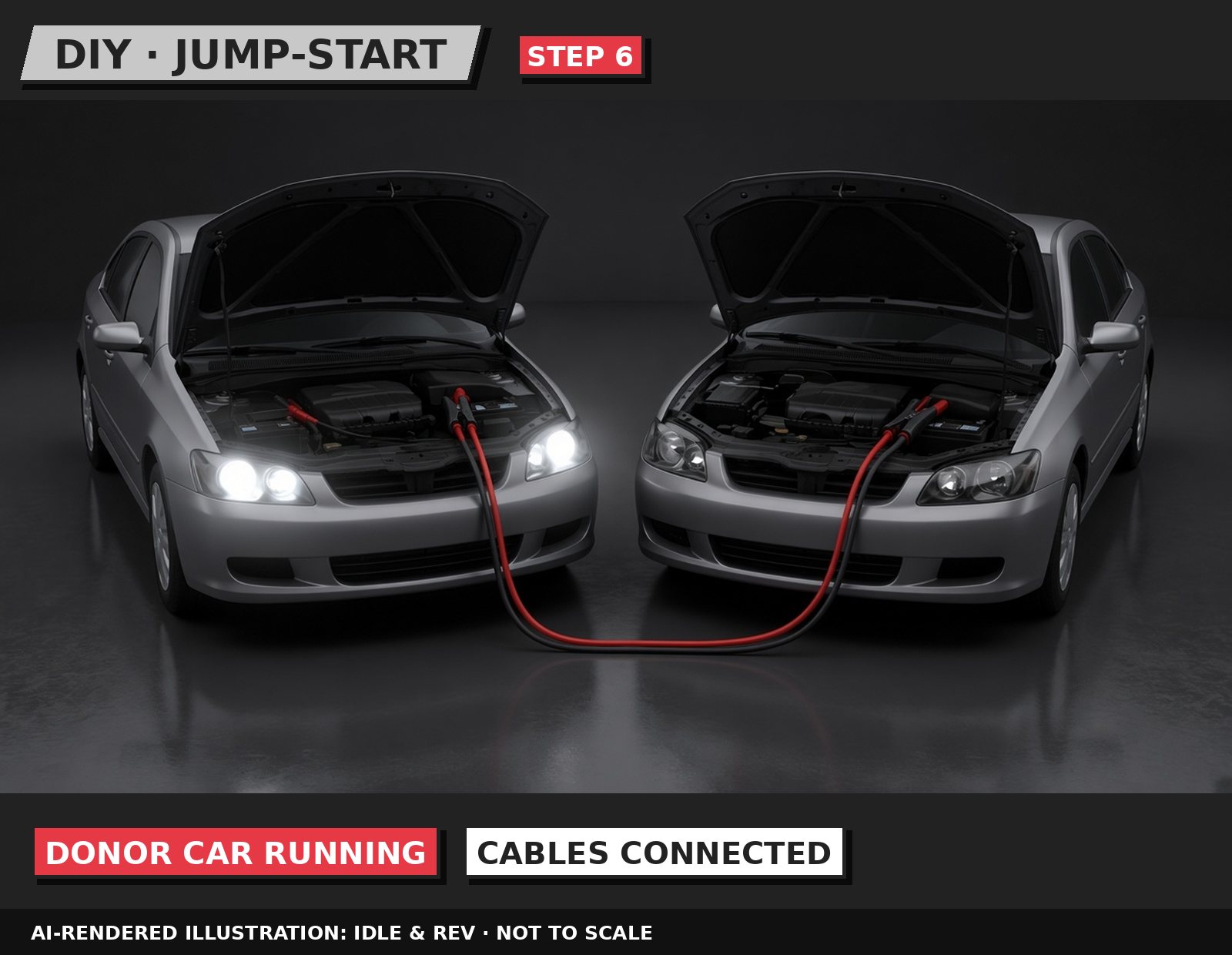
Illustration: Idle & Rev (AI-rendered, for illustration; not to scale) - Start the dead carTry starting the car with the dead battery. If it doesn't start, check the clamps, wait a few more minutes and try again.
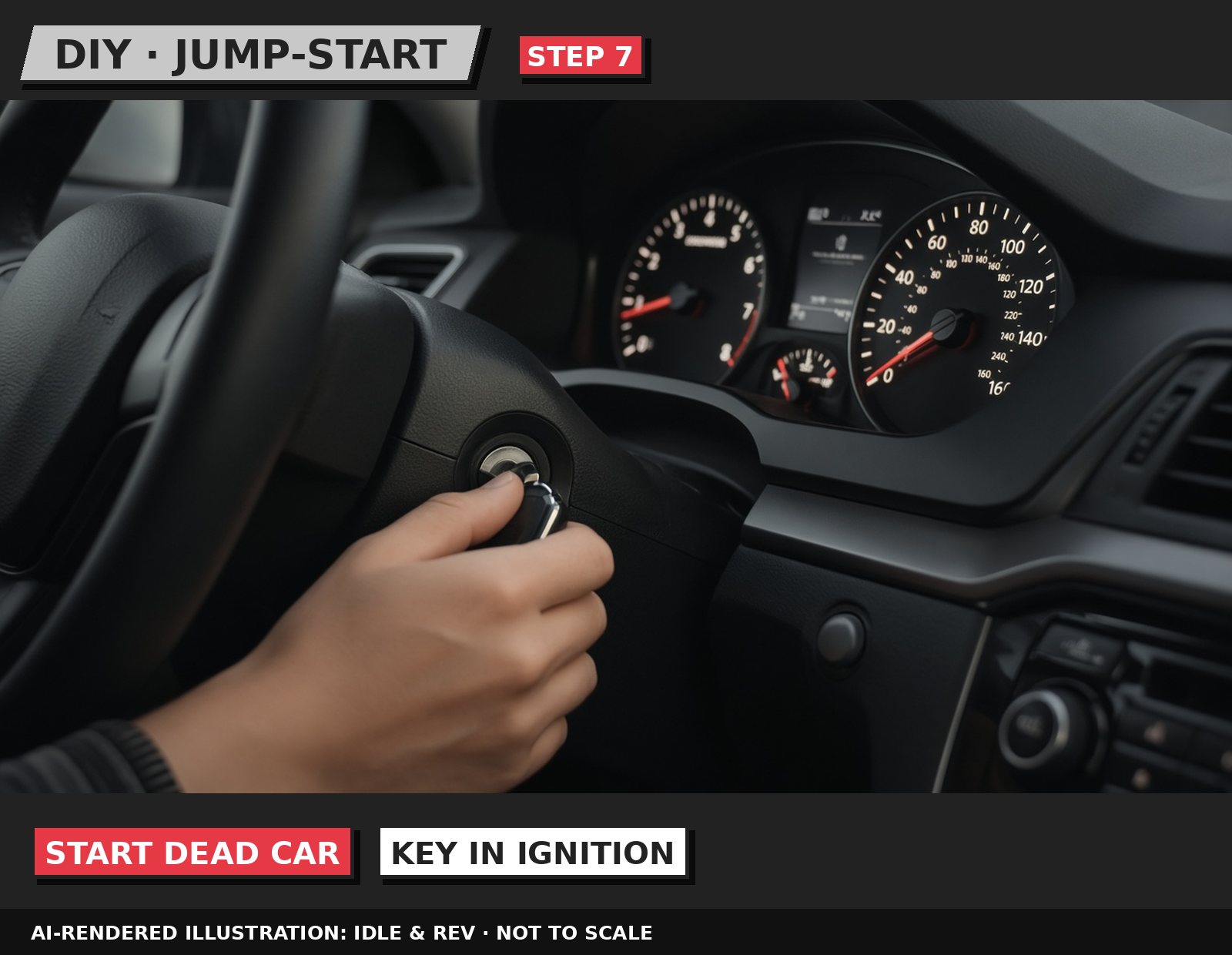
Illustration: Idle & Rev (AI-rendered, for illustration; not to scale) - Disconnect in reverse orderWith both cars running, remove the clamps in exact reverse order: black from the ground point, black from the donor, red from the donor, then red from the car you just started. Don't let the clamps touch.
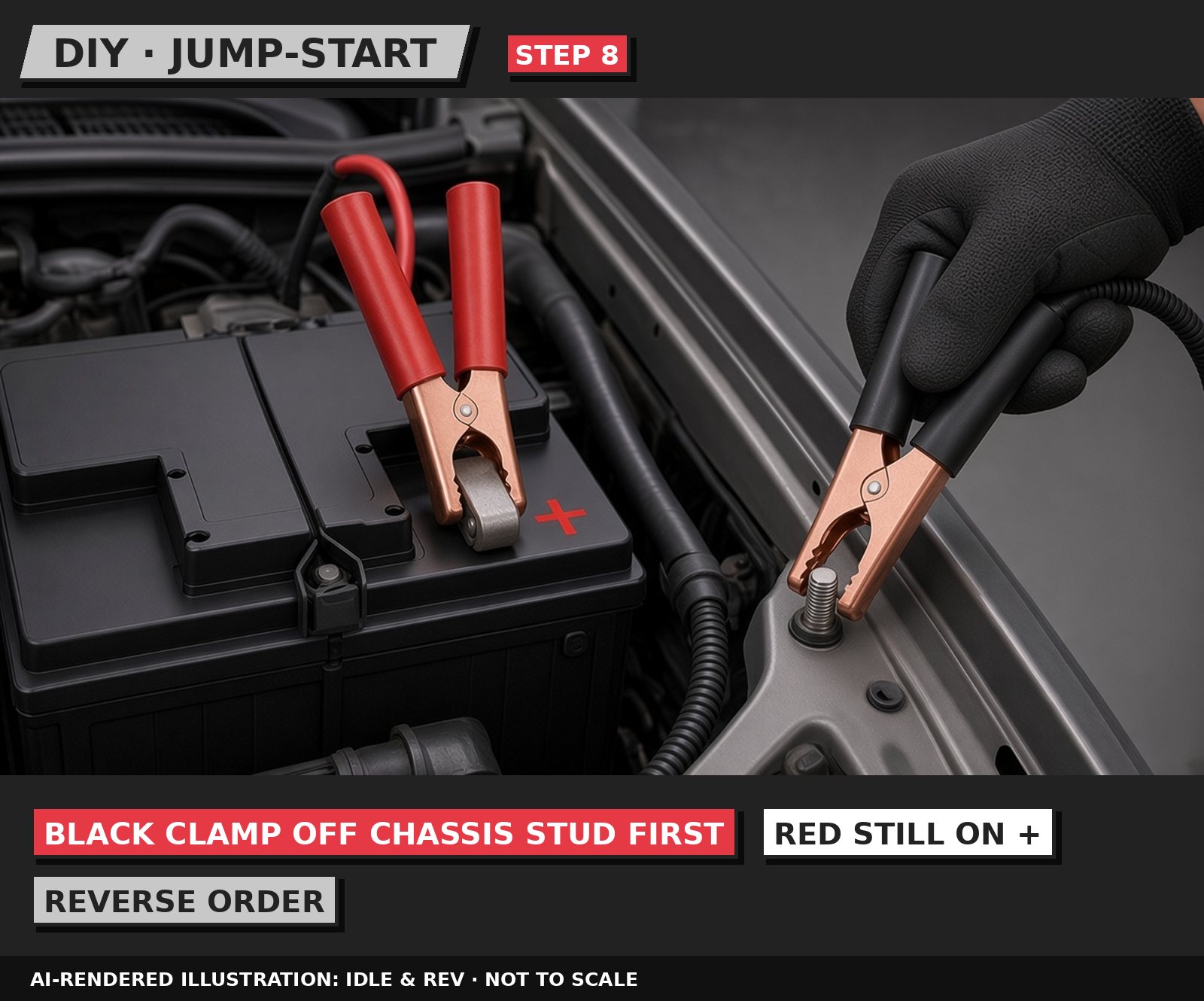
Illustration: Idle & Rev (AI-rendered, for illustration; not to scale) - Keep it runningConsumer Reports recommends letting the revived car run for at least 20 minutes, or going for a drive, so the battery can recharge before you shut it off.
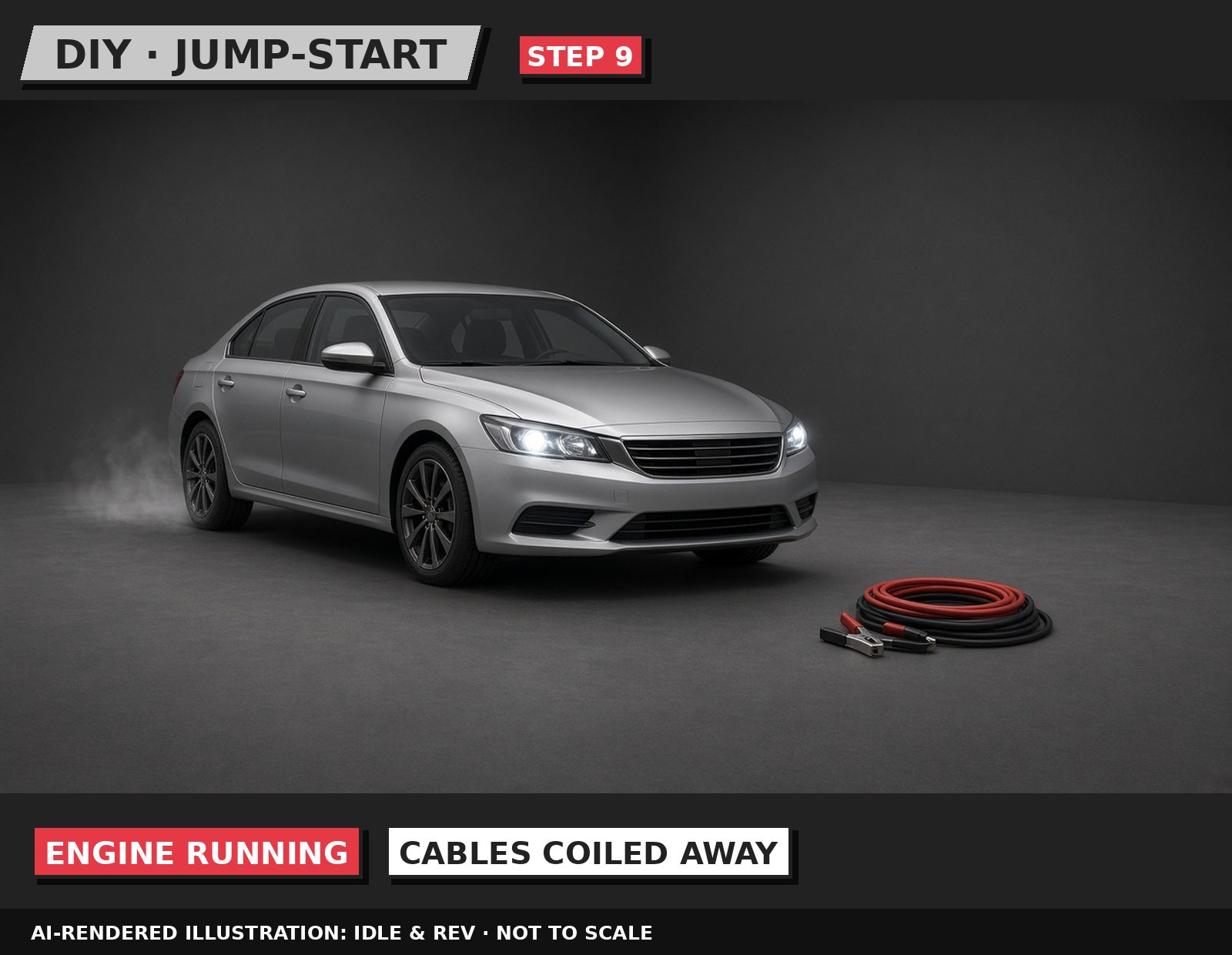
Illustration: Idle & Rev (AI-rendered, for illustration; not to scale)
If it still won't start
If the engine only clicks or cranks slowly, check that every clamp is biting clean metal and let the donor car run a few more minutes. If it still won't start, the problem may be the starter, the alternator or a battery that can no longer hold a charge. Consumer Reports suggests calling for service at that point. A battery that needs repeated jumps should be tested; most auto parts stores will do it for free.
Using a portable jump starter
The AA notes the same logic applies: connect the pack's red clamp to the battery's positive terminal and its black clamp to an unpainted earthing point on the engine or chassis, then switch the pack on and start the car. Follow the pack's instructions.
Sources: AAA: How to jump a battery, Consumer Reports: How to jump-start a car, The AA: How to jump start a car