
How Pontiac's Tri-Power three-carburetor setup works
4 min read
Three cheap two-barrel carbs, one doing the daily work and two waiting for full throttle: the trick behind the 348-hp 1964 GTO.
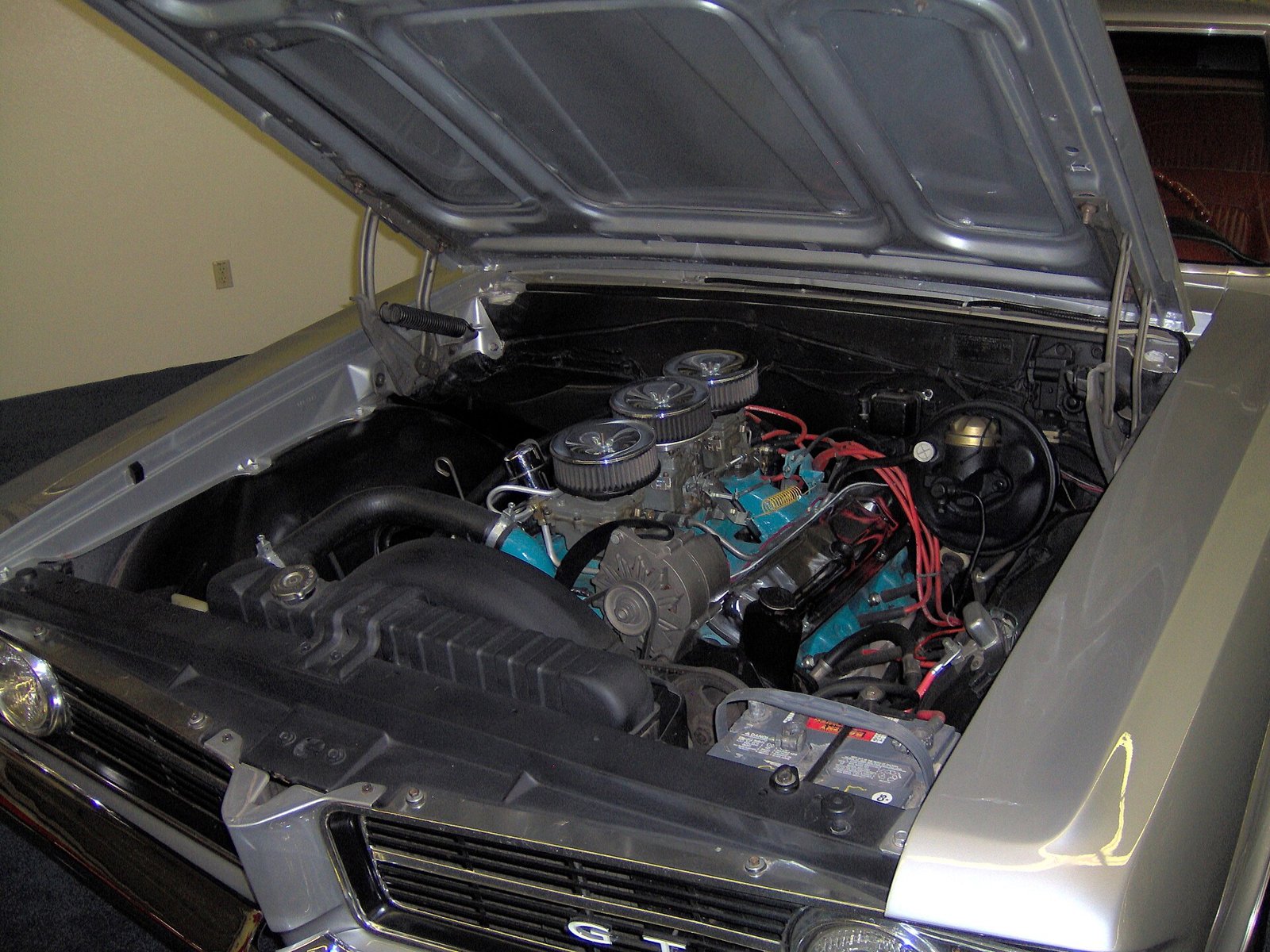
Pop the hood on a 1964 Pontiac GTO with the Tri-Power option and you see three carburetors lined up in a row on top of the 389 V8. It looks like a race engine. In reality, the idea behind it is simple: use one small carburetor for everyday driving, and bring in two more only when the driver floors it. Here's how it works and why Pontiac built it.
What Tri-Power is
Tri-Power was Pontiac's name for a setup of three two-barrel carburetors on its big performance V8s in the late 1950s and 1960s. According to Wikipedia's summary, the three were Rochester 2G carburetors mounted in a line on the intake manifold. The center one worked like a normal carburetor, and the front and rear units acted as secondaries, sometimes called "dumpers," for full-throttle performance. Cars with the option often had a hood bulge to clear the carbs and Tri-Power badging outside.
Mac's Motor City Garage reports that Pontiac offered Tri-Power on select models from 1957 through 1966, on engines of 347, 370, 389 and 421 cubic inches. For 1967 it was replaced by the Rochester Quadrajet, a more modern four-barrel carburetor.
Why Pontiac used three small carbs
The story starts with cost. Mac's Motor City Garage says that for two years starting in 1957, Pontiac offered Rochester mechanical fuel injection, similar to Chevrolet's. It worked, but it had problems with reliability and serviceability, and it cost about $500 per car.
Racers and hot rodders had long gotten more power by simply bolting on more ordinary carburetors, and Pontiac followed their lead. Rochester's 2G two-barrel, introduced in 1955, was simple, cheap and tough. Mac's estimates each one cost Pontiac perhaps $5 to $10, which let it sell Tri-Power for only about $90 to $100 per car. That was a fraction of the cost of fuel injection or a pair of expensive four-barrels.
How it works: one carb for cruising
The key is that the three carburetors don't all do the same job. According to Mac's Motor City Garage, only the center carburetor works when starting the engine and at low speeds. That keeps the engine drivable and gives reasonable fuel economy around town.
The two end carburetors are stripped down. Mac's says they have no chokes and no idle circuits, only main circuits and accelerator pumps. The main circuit supplies fuel when the throttle is open, and the accelerator pump squirts extra fuel when the throttle opens suddenly. Because they have no idle circuit, they simply stay shut until they're needed.
How it works: two more for full throttle
When the driver opens the throttle wide, the front and rear carburetors open too. On many Tri-Power cars, Mac's says, this was done progressively by a vacuum servo. HotCars describes that type as working off the venturi effect of air rushing into the engine. HotCars notes that vacuum linkage tended to open both end carbs at once.
The other approach was a mechanical progressive linkage connected to the throttle, which HotCars says opened the end carbs in sequence for smoother response. Mac's Motor City Garage reports that on GTOs with a manual transmission, the vacuum-operated system was replaced by a mechanical progressive linkage. Linkage details varied by year, so restorers check what's correct for a specific car.
Mac's sums it up this way: the system worked much like a regular progressive four-barrel carburetor, where the secondary barrels only open at high demand, but with better breathing, since it had six throttle bores instead of four.
What it meant for the 1964 GTO
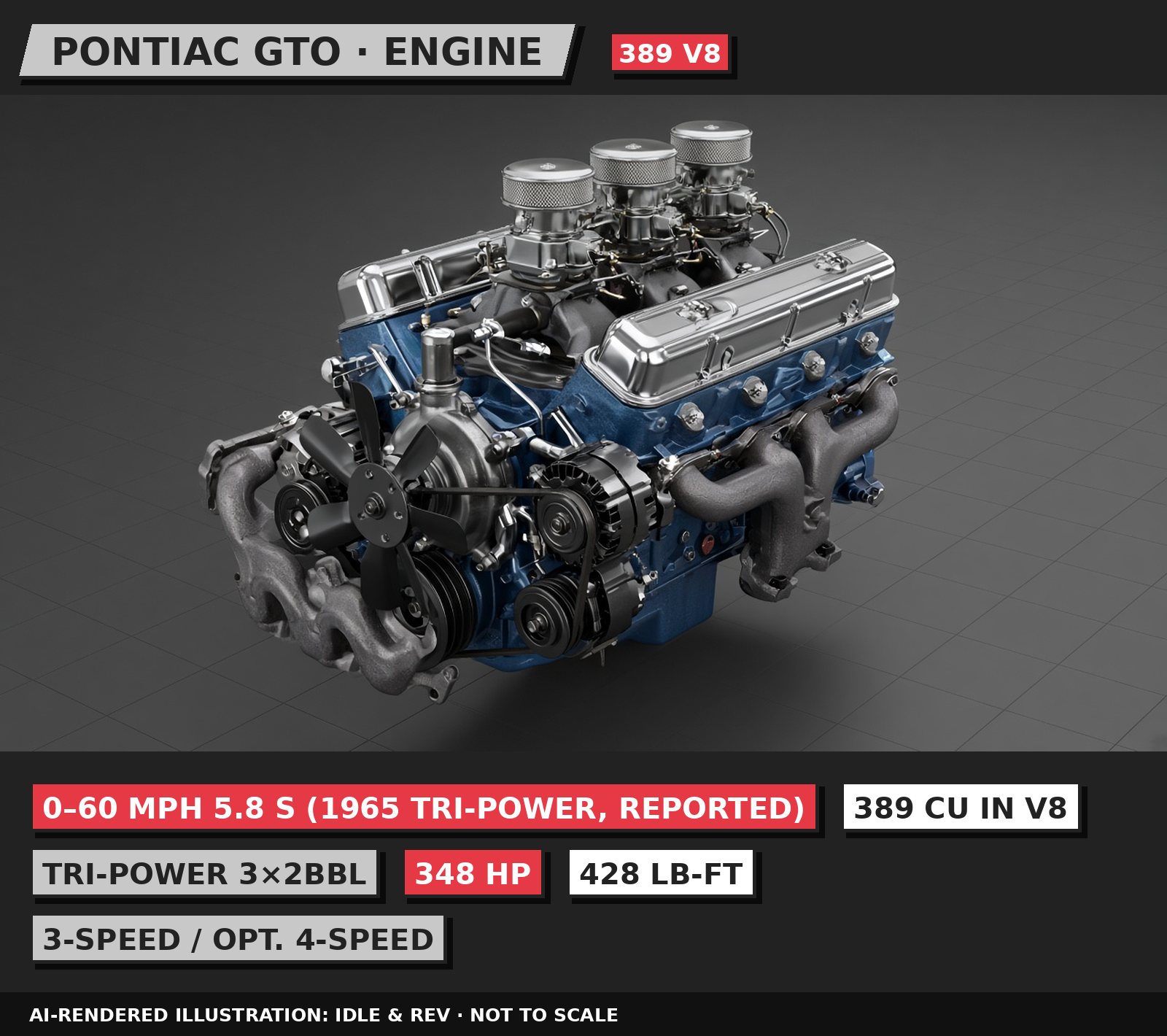
In 1964, the GTO's standard 389 used a single four-barrel and was rated at 325 hp at 4,800 rpm and 428 lb-ft at 3,200 rpm, according to Pontiac's brochure specs as listed by Car Back Catalogue. With Tri-Power, the rating rose to 348 hp at 4,900 rpm, with the same 428 lb-ft at 3,600 rpm. That's 23 more horsepower from the same engine, mainly from the extra breathing at high rpm.
Wikipedia reports that Car Life tested a 1965 GTO with Tri-Power, a close-ratio four-speed and a 4.11 limited-slip axle at 5.8 seconds from 0 to 60 mph. Mac's also notes that Motor Trend reported at the time that Tri-Power was slightly but measurably quicker than Pontiac's earlier fuel-injection setup.
A name that stuck
Other GM divisions offered their own three-two-barrel Rochester setups, including Oldsmobile's J-2, Cadillac from 1958 to 1960, and Chevrolet on its 348 V8, according to Mac's. The Tri-Power name belonged to Pontiac, but enthusiasts started calling any three-carb setup "tri-power," the same way Chevrolet's Positraction became shorthand for any limited-slip differential.
If you're shopping for a Tri-Power Pontiac, it's worth confirming the setup is original to the car and that all three carburetors and the linkage are in proper working order.
Related: Car of the Day: 1964 Pontiac GTO
Sources: Mac's Motor City Garage: The Pontiac Tri-Power Story, HotCars: The History and Mystery of Pontiac's Tri-Power Engines, Wikipedia: Tri-Power, Wikipedia: Pontiac GTO, 1964 GTO brochure specs (Car Back Catalogue)